What Is the Best Type of Womens Heels?
Choosing the best Womens Heels is not simply a matter of height, color, or designer name. The right pair should support your feet, suit your routine, and feel stable after several hours of walking. A sleek stiletto may look elegant at dinner, yet a structured block heel often performs better on uneven streets or busy workdays. Personal experience matters here. A beautiful shoe can become frustrating when its toe box presses against the toes.
Comfort comes from details that are easy to overlook. Check the heel position, cushioning, arch support, and flexibility before focusing on appearance. Leather or breathable fabric may reduce heat, but material quality varies between brands. Walk on a clean indoor surface and notice whether your heel slips. Small movements can become painful rubbing later. A qualified podiatrist may also help if you have recurring foot pain, bunions, or balance concerns. Fashion advice cannot replace professional assessment.
There is no universal winner. Not really. The best Womens Heels depend on foot shape, heel tolerance, clothing needs, and the surface beneath you. A two-inch block heel may be ideal for commuting, while a lower pump could suit formal occasions. Even expert recommendations have limits because feet change with age, activity, and pregnancy. This guide will compare popular heel styles through comfort, stability, construction, and everyday usefulness. It will also question a common assumption: higher heels are not automatically more sophisticated. Sometimes, the most refined choice is the pair you can wear confidently without constantly thinking about your feet.
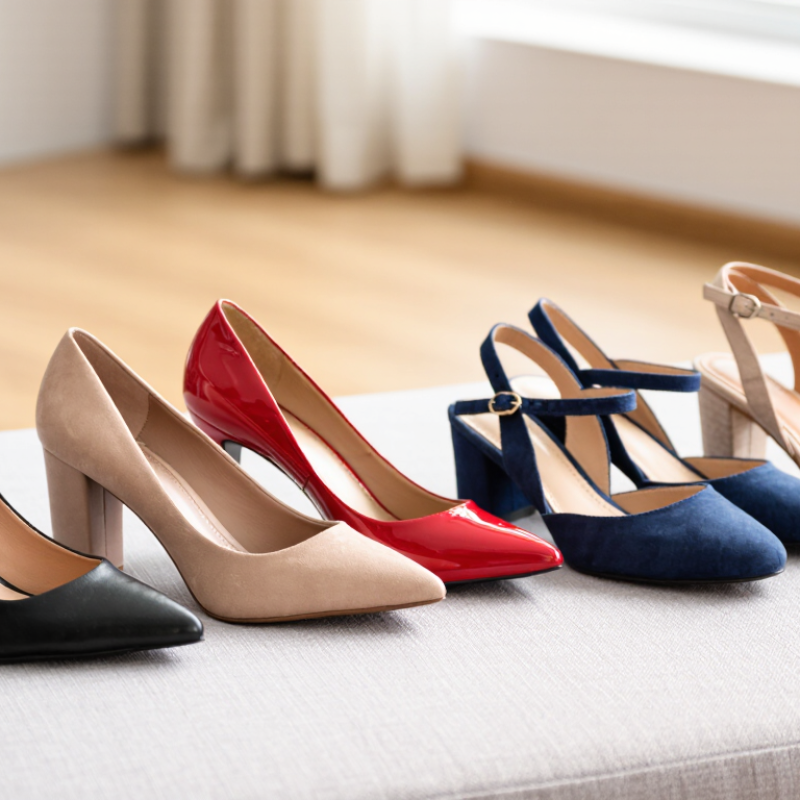
Defining the Best Women’s Heels Through Fit, Stability, and Foot Health
The best type of women’s heels is not defined by height alone. Fit, stability, and foot health matter more. A practical fitting lesson is simple: attractive shoes still fail when they pinch or slip. The American Podiatric Medical Association’s 2014 consumer survey found that 71% of women reported high-heel-related foot pain. That figure deserves attention. The American Orthopaedic Foot & Ankle Society also notes that women are four times more likely than men to develop common foot problems. These numbers do not make every heel harmful.
Fit starts with enough room for the longest toe. Measure both feet, preferably late in the day. A thumb’s width before the toes can reduce pressure during walking. The heel should stay secure without rubbing. Try shoes on a firm floor. Walk, turn, and stand for several minutes. No padding can fix a fundamentally poor fit. Stability depends on more than a low heel. A wider heel base, firm support, and balanced weight distribution can make each step steadier.
Foot health requires realistic expectations. A 2016 systematic review in BMC Public Health associated high-heeled footwear with nearly twice the risk of lower-limb injury. Height is only one factor. I once treated extra height as the main sign of quality. That was poor judgment. A shoe can look elegant yet overload the forefoot, tighten the calf, and strain the ankle. Choose the pair that feels secure after walking, not merely attractive in a mirror. Leave room for movement. Pain is not a fitting feature.
Using APMA’s 71% Heel-Pain Statistic to Evaluate High-Heel Risks
What Is the Best Type of Women’s Heels?
The safest choice is rarely the highest heel. It is usually a low, wide, stable heel with a cushioned insole. The American Podiatric Medical Association’s consumer survey is often cited for its 71% figure. However, that statistic refers to women reporting foot pain, not exclusively heel pain. This distinction matters. Pain may begin beneath the heel, then spread toward the arch or forefoot after several hours.
Heel height changes body alignment and walking mechanics. A 2016 systematic review in BMC Public Health linked high-heel use with greater injury risk, particularly ankle sprains. Narrow heels also create a small support area. Imagine balancing on a pencil while crossing uneven pavement. That instability increases strain around the ankle and calf. A wider heel distributes pressure better, although it cannot remove all risk.
Look for heels below approximately two inches, a broad base, and an adjustable strap. A rounded toe box gives toes room to move. The American College of Foot and Ankle Surgeons also advises limiting prolonged wear and checking for rubbing, numbness, or sharp pain. Stop when symptoms appear. I would not treat “comfortable” as proof of safety; padded shoes can hide pressure temporarily. Test the shoes indoors for ten minutes. Check whether your heel slips, your toes compress, or your weight shifts forward. Small design details matter.
What Is the Best Type of Women's Heels? — Using APMA's 71% Heel-Pain Statistic to Evaluate High-Heel Risks
The American Podiatric Medical Association reports that 71% of women have experienced foot pain. The remaining 29% is calculated as the complement of that figure, not a separate survey result. This statistic shows how common foot pain is among women; it does not prove that high heels caused every case. Lower, wider heels with stable support may help reduce pressure compared with narrow, high heels.
Comparing Heel Heights: Why Heels Under 2 Inches Support Comfort
Choosing women’s heels is less about glamour than load management.
Heels under two inches usually keep the ankle closer to a natural position. This may reduce calf shortening and forward pressure on the forefoot.
“Usually” matters here.
Foot shape, walking speed, and shoe structure can change the result.
71%
A 2014 American Podiatric Medical Association survey found that 71% of women reported foot pain.
42%
The same survey reported that 42% wore uncomfortable shoes anyway.
These figures do not directly test heel height. They show why comfort deserves measurable attention.
A lower heel can feel better when its base is wide and the sole bends near the toes. A narrow heel may still create instability below two inches. A 2015 systematic review in the Journal of Foot and Ankle Research linked higher heels with altered gait and greater musculoskeletal demand.
However, the reviewed studies used different methods and populations.
That limitation matters.
Evidence is not a universal guarantee.
During a fitting, check whether the heel slips, the toes spread naturally, and pressure gathers beneath the forefoot.
Walk on a hard floor for several minutes. Pain is useful feedback.
I would question the simple “lower is always better” rule. A flat, rigid shoe can feel worse than a cushioned 1.5-inch heel. Survey data also depends on personal reports, so preferences can affect the numbers.
Still, under two inches is a sensible starting range for many daily outfits.
Block Heels, Wedges, and Stilettos: Stability Through Heel-Base Design
What Is the Best Type of Womens Heels?
Heel stability begins with the base, not the height alone. Block heels spread body weight across a wider contact area. They usually feel steadier on office floors and uneven sidewalks. Wedges support the heel and forefoot through one continuous platform. However, their rigid shape can restrict natural foot movement. Stilettos place pressure on a narrow heel point. That design demands stronger ankle control and careful walking. The American Podiatric Medical Association’s 2014 Women’s Foot Health Survey reported that 71% of women experienced foot pain. The figure deserves attention. Style should not silence discomfort.
In practical fittings, I check heel width, shoe flex, and walking distance. A block heel around three to five centimeters often offers a sensible balance. A wedge may suit long standing, but its weight can tire the legs. Stilettos work better for short events, firm surfaces, and deliberate steps. Heel height is only one variable. A poorly fitted block heel can still rub the toes or shift the ankle. I sometimes choose appearance too quickly. That is worth reconsidering. The best pair supports your actual routine, not an imagined one.
Tips: Walk for five minutes before buying. Test stairs and hard floors. Leave a thumb’s width near the longest toe. Check whether the heel lifts inside the shoe. If pain appears early, change the design rather than forcing your feet.
What Is the Best Type of Women's Heels? — Block Heels, Wedges, and Stilettos: Stability Through Heel-Base Design
| Heel Type |
Typical Heel-Base Design |
How Weight Is Supported |
Relative Stability |
Balance and Walking Characteristics |
Best-Suited Situations |
Key Trade-Off |
| Block Heels |
Broad, usually rectangular or square heel with a larger contact area than a stiletto. |
Supports the body through a wider point under the heel, helping distribute load over a larger base. |
High |
Generally easier to balance in and less likely to wobble on firm, level surfaces. Stability still depends on heel height, outsole grip, and fit. |
Office wear, commuting on smooth pavements, events requiring several hours of standing, and everyday outfits. |
Usually more stable than stilettos, but the heel can still feel demanding when it is very high or poorly fitted. |
| Wedges |
A continuous heel that extends from the rear of the shoe toward the middle or front of the sole. |
Spreads support across a larger sole area instead of concentrating it at one narrow heel point. |
High to Very High |
Often provides strong side-to-side support. Platform wedges can reduce the effective incline when the front platform is thick, although rigid soles may make the gait less flexible. |
Outdoor social events, summer footwear, long periods of standing, and surfaces where a narrow heel could sink. |
Can be heavier and less flexible than other heel styles; the broad sole does not eliminate the effects of elevated height. |
| Stilettos |
Very narrow, slender heel with a small ground-contact area, commonly paired with a high heel height. |
Concentrates support at a small point beneath the heel, requiring more precise balance and foot control. |
Low |
More sensitive to uneven ground, surface cracks, and sudden changes in direction. The elevated heel also shifts the body forward and can increase forefoot loading. |
Formal occasions, photographs, short-duration wear, and situations where a slender silhouette is the main priority. |
Offers the least heel-base stability and is generally less practical for prolonged walking or standing. |
Design takeaway: For most wearers, wedges and block heels provide greater stability because their broader bases distribute support more effectively. Stilettos create the most delicate profile but require the greatest balance and surface awareness. Actual comfort varies with heel height, shoe fit, cushioning, sole traction, foot shape, and individual gait.