China remains an important sourcing base for boots, with manufacturers serving workwear, outdoor, fashion, and private-label markets. Yet a polished catalogue does not reveal how a factory handles fit, materials, or production changes. Buyers need details they can verify.
This guide introduces ten Chinese boot manufacturers for global buyers. It considers product focus, customization, production capabilities, communication, and the evidence buyers should request. Boots Shoe sourcing expert Lin Wei offers a practical reminder: “A reliable supplier proves consistency in the sample, not just confidence in the sales pitch.” Ask for material specifications, size grading, quality-control steps, and clear sample timelines. Check whether the factory can explain its process plainly.
Small details matter. A stiff collar can rub. A sole may look sturdy but feel slippery on a wet test surface. Samples should be assessed against written requirements, not memory. Supplier claims also deserve careful review; this outline is a starting point, not an independent factory audit. Buyers should confirm current capabilities, order terms, and relevant product documentation directly with each manufacturer. Some information may change between orders. That deserves a second look. By comparing suppliers with consistent questions, buyers can narrow the field and make better-informed sourcing decisions.
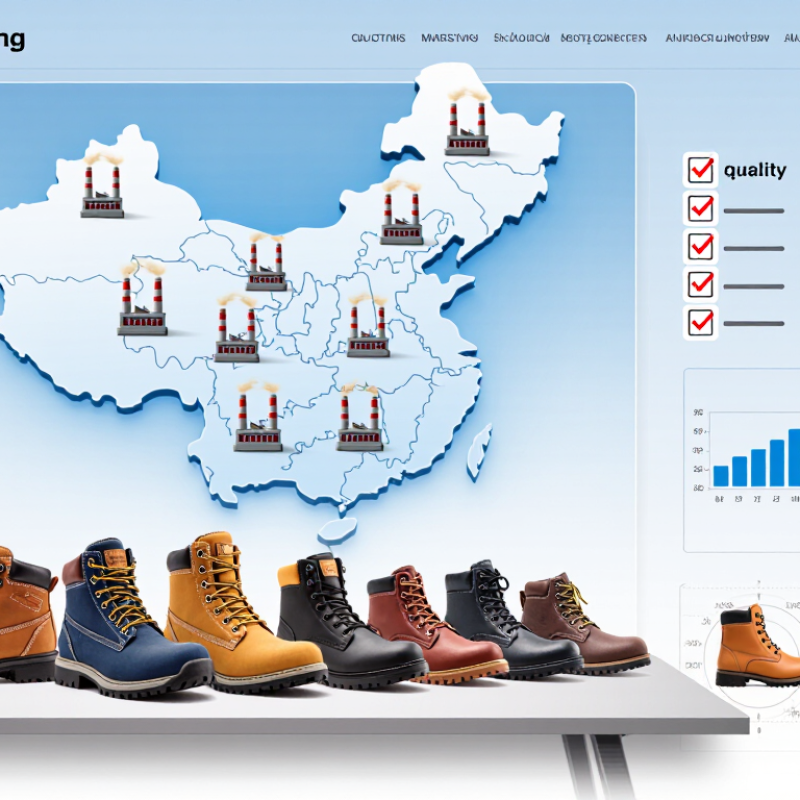
In 2022, China produced 54.6% of the world’s footwear, according to the figure cited in this article’s subtitle. That scale reflects a deep manufacturing base, established materials networks, and the ability to handle large production runs. For global buyers sourcing boots, it can mean more supplier options and access to varied construction methods. But footwear includes many product types. The figure does not mean China made 54.6% of the world’s boots.
A statistic is not a factory audit. Buyers still need to assess each manufacturer’s experience with their specific boot design, materials, and quality requirements. Ask how samples are checked, how sizing is kept consistent, and what happens when an inspection finds defects. A clear answer matters more than an impressive production claim. Details count: inspect sole bonding, stitching around stress points, and the finish inside the boot.
Large output can offer useful flexibility, but capacity varies by factory and season. Check production timelines against sample results, and confirm that quoted materials match the approved sample. This takes time. It can feel repetitive, yet that scrutiny helps buyers distinguish genuine manufacturing capability from broad national statistics.
For global buyers, boot style matters, but the safety marking matters more. ISO 20345:2021 sets requirements for safety footwear, including toe protection tested against 200 joules of impact and 15 kilonewtons of compression. These tests do not make every boot suitable for every workplace. A warehouse floor, wet loading dock, and construction site create different risks.
Check the category and added markings on the product label and declaration. S1 footwear suits many dry, indoor environments, while S3 models add features intended for tougher conditions, such as water penetration resistance and puncture-resistant soles. The exact protection depends on the marked classification and tested features. Slip resistance is also worth checking, but laboratory results cannot fully predict grip on every oily or uneven surface. A label alone is not the whole story.
Tips: Match markings to a written hazard assessment. Inspect the sole, seams, and toe area on a sample pair. Ask for current test documentation against ISO 20345:2021, and confirm sizes, fit, and replacement availability. Small details can be missed, even by experienced buyers.
Buyer-focused overview of ten common safety-footwear manufacturing specializations. The entries describe product categories, not ranked or verified individual manufacturers. Safety features and markings must be confirmed for each specific model.
| No. | Manufacturing Specialization | Typical Boot Type | Relevant ISO 20345:2021 Classification or Marking | Safety Criteria to Verify | Buyer Checks |
|---|---|---|---|---|---|
| 1 | General industrial safety footwear | Leather or textile safety shoes and ankle boots for dry indoor workplaces | SB or S1, depending on the required features | Safety toe cap tested for 200 J impact and 15 kN compression. S1 adds a closed heel, antistatic properties, and energy absorption in the heel. | Check the exact classification, fit, toe-cap test documentation, and whether antistatic properties are suitable for the worksite. |
| 2 | Water-resistant leather footwear | Work boots for damp conditions and occasional exposure to water | S2 | S2 includes the applicable S1 features and resistance to water penetration and absorption in the upper (WPA). | WPA is not the same as whole-footwear water resistance. Confirm the intended exposure level and care instructions. |
| 3 | Construction and general outdoor footwear | Mid-cut or high-cut boots with a cleated outsole | S3, S3L, or S3S | These classifications combine core safety-footwear requirements with water penetration and absorption requirements for the upper, a cleated outsole, and the applicable penetration-resistance option. | Check whether the model uses a metal insert or a non-metallic insert, and confirm the precise marking and test results. |
| 4 | Non-metallic puncture-resistant footwear | Lightweight safety boots for construction, maintenance, and mobile work | S3L or S3S; corresponding non-metallic penetration-resistance markings may also apply | “L” and “S” identify different test nail sizes for non-metallic penetration-resistant inserts: 4.5 mm and 3.0 mm, respectively. | Ask which penetration test was passed and verify the marking on the footwear and its documentation. Do not assume all protective inserts provide identical coverage. |
| 5 | Rubber and polymeric safety footwear | Waterproof-style boots for wet, muddy, or washdown environments | S4 | S4 applies to footwear made from rubber or polymeric materials and includes a safety toe cap, antistatic properties, and heel energy absorption. | Confirm material suitability, chemical compatibility where relevant, outsole grip, and the exact conformity documentation. |
| 6 | Rubber and polymeric puncture-resistant footwear | Protective wellington-style boots for wet sites with underfoot hazards | S5, S5L, or S5S | These classifications add penetration resistance and a cleated outsole to the applicable S4 requirements. “L” and “S” indicate different non-metallic insert test nail sizes. | Check penetration-resistance type, outsole tread, boot height, and whether the material suits the site’s liquids and cleaning process. |
| 7 | Whole-footwear water-resistant safety boots | High-cut boots intended for work in persistently wet conditions | WR; applicable S6 or S7 variants may be specified | WR indicates resistance to water penetration in the complete footwear. The S6 and S7 family combines WR with other classification requirements; the exact variant should be checked. | Distinguish whole-footwear WR testing from upper-only WPA testing, and confirm the full classification printed on the product. |
| 8 | Heat-resistant outsole footwear | Safety boots for hot floors and industrial work areas | HRO as an additional marking, where applicable | HRO denotes outsole resistance to contact heat under the standard test. It does not by itself certify protection from molten metal or all heat hazards. | Confirm the temperature and exposure limits in the product documentation. Foundry and welding hazards may require additional, task-specific standards. |
| 9 | Cold-environment safety footwear | Insulated safety boots for outdoor work and cold workplaces | CI as an additional marking, where applicable | CI indicates tested cold insulation of the footwear sole complex. It is not a complete rating of wearer comfort or protection for every cold-weather condition. | Review the insulation test information, sock and insole compatibility, fit, and the expected temperature and duration of exposure. |
| 10 | Special-purpose safety footwear | Boots designed for electrical, chemical, forestry, or other specialized hazards | ISO 20345 classification may apply alongside separate hazard-specific standards | ISO 20345 safety-toe and footwear classifications do not alone establish electrical insulation, chemical protection, or chainsaw-cut protection. Antistatic footwear is not electrically insulating footwear. | Identify the hazard first and request the applicable separate standard, test report, and model-specific certification before purchase. |
Procurement note: ISO 20345:2021 classifications describe tested footwear requirements; they are not a substitute for a workplace risk assessment. Verify the current certificate, declaration of conformity, product marking, size range, and test reports for the exact model being purchased.
China’s boot manufacturers serve varied needs, from leather ankle boots and insulated winter styles to rubber rain boots and protective work footwear. Their strengths are not identical. Some focus on high-volume basics, while others handle smaller runs, custom lasts, or mixed-material designs. Export markets often include North America, Europe, and other regions, but product requirements differ by buyer and destination. OEM services may cover pattern development, material sourcing, private-label packaging, and sample revisions. Ask what each factory performs in-house.
Tips: Request a sample in your target materials and size range. Check stitching, sole bonding, lining, and fit after repeated wear. Small details matter.
When comparing ten manufacturers, look beyond catalog photos. Ask for production capacity, minimum order quantities, lead times, and quality-control steps in writing. A factory may offer many styles but have limited experience with your preferred construction. Confirm that its sample matches the quoted materials and specifications. Review inspection records where available, and discuss how defects or delays are handled. I would not treat a polished showroom as proof of consistent production; that assumption can be costly. Clear specifications and a documented sample approval process help buyers assess OEM readiness with fewer surprises.
Industry-wide context for buyers assessing Chinese boot manufacturers
China accounted for 54.6% of global footwear production and 63.8% of global footwear exports in 2022. These figures cover footwear overall, not boots specifically, and indicate the scale of China’s footwear supply base rather than the performance of any individual manufacturer. Source: World Footwear Yearbook 2023.
China’s boot suppliers should be compared on evidence, not factory photos. The World Footwear Yearbook 2024 reported 22.4 billion pairs of footwear produced worldwide in 2023, with Asia accounting for 88% of output. This scale provides context, but footwear totals do not prove a factory’s boot-making capacity. Request monthly output by boot type, current utilization, and production records for a similar order.
Compare MOQ by style, color, and size mix; a quoted minimum may apply per color, not per shipment. Ask suppliers to separate sample, material-sourcing, and bulk-production lead times. Confirm when the clock starts. One uncomfortable truth: a clean spreadsheet can still overstate capacity. Request a recent production schedule and verify it against line count and worker shifts. For relevant safety footwear, check whether reports identify the tested model, test date, laboratory, and applicable methods, such as ISO 20344 and ISO 20345.
Tips: Ask for a redacted test report and a sample from the same material batch. Compare results with your product specification, not just a “pass” label. If the report’s model code differs from the quotation, pause and ask why. A small discrepancy may be explainable, but it should not be ignored.
China’s footwear scale makes supplier verification essential. The World Footwear Yearbook 2023 reports that Asia produced 87.4% of the world’s footwear in 2022. For buyers comparing manufacturers, capacity alone is not proof of dependable production. The OECD’s Garment and Footwear Due Diligence Guidance sets out a six-step, risk-based approach. Ask suppliers for facility details, material records, and evidence that relevant product requirements are understood. Paperwork is not proof.
Quality control should be visible on the factory floor. Agree on a written inspection plan before production, including sample approval, size-run checks, sole-bond testing, and carton-label verification. Keep dated photos and test records tied to each order. A polished sample can hide inconsistent stitching or uneven sizing in bulk production. I have seen inspection plans become too broad to be useful; define measurable pass criteria instead.
Tips: Request a recent production sample, a clear defect-reporting process, and draft export documents before deposit. Check that product descriptions, quantities, and carton marks match across documents. Confirm who handles testing and freight coordination, and record unresolved points in writing.